Thermofrigopumps
VQ60
VQ60
Thermofrigopumps allow for the simultaneous production of cold and heat from the same installation. They recover the heat usually rejected by a refrigeration system to utilise it in the form of hot water or process heat.
This dual energy recovery significantly enhances the overall efficiency of the system: the same electrical consumption meets both the cooling needs and a substantial portion of the heating requirements.
From an economic perspective, thermofrigopumps allow for the simultaneous reduction of electricity consumption related to cooling and the consumption of gas or steam related to heating. They are particularly relevant in industrial sites where the needs for cooling and heating are concurrent.
Well integrated into the process, a thermodynamic heat pump can thus offer a very attractive return on investment time, while sustainably reducing CO₂ emissions and dependence on fossil fuels.
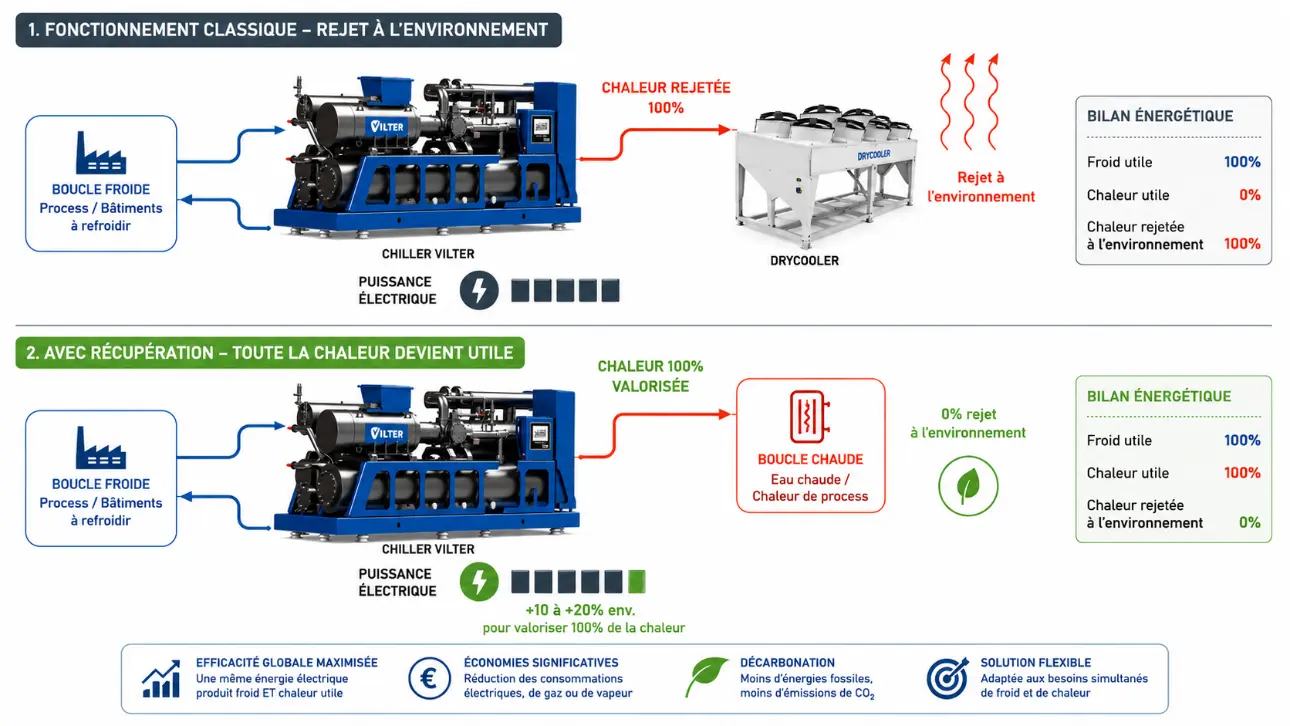
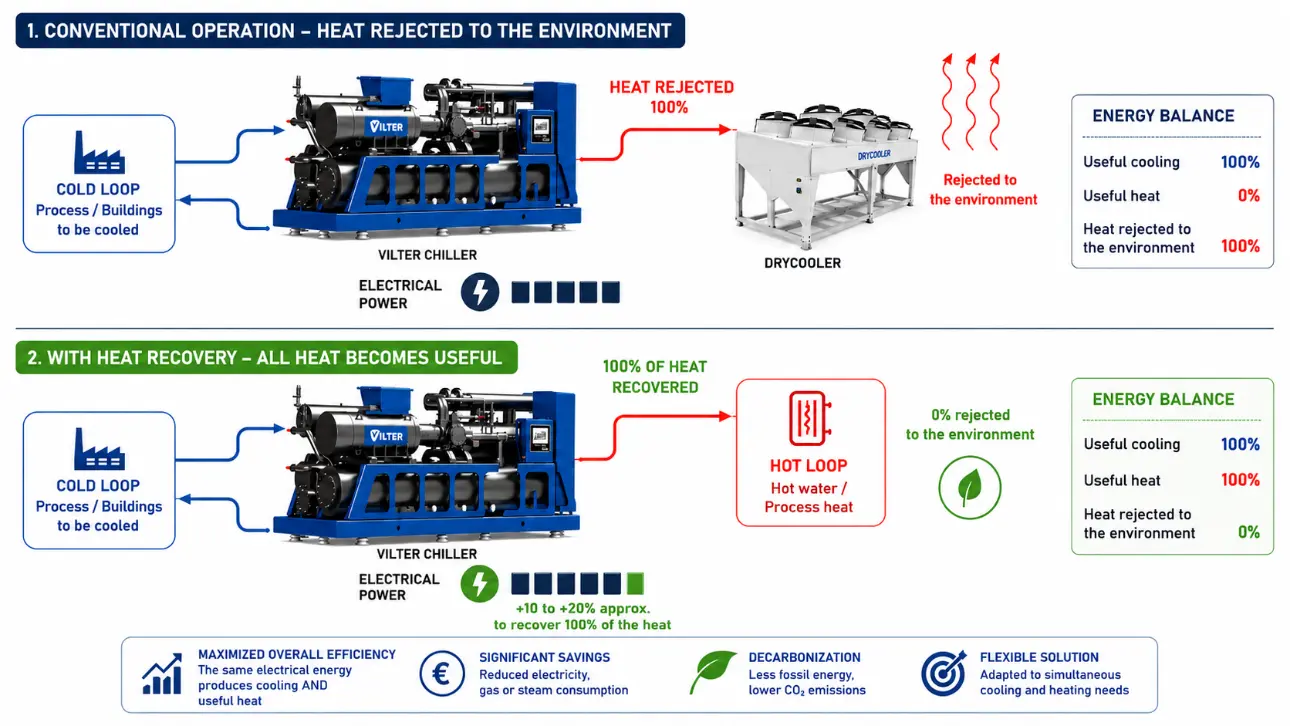
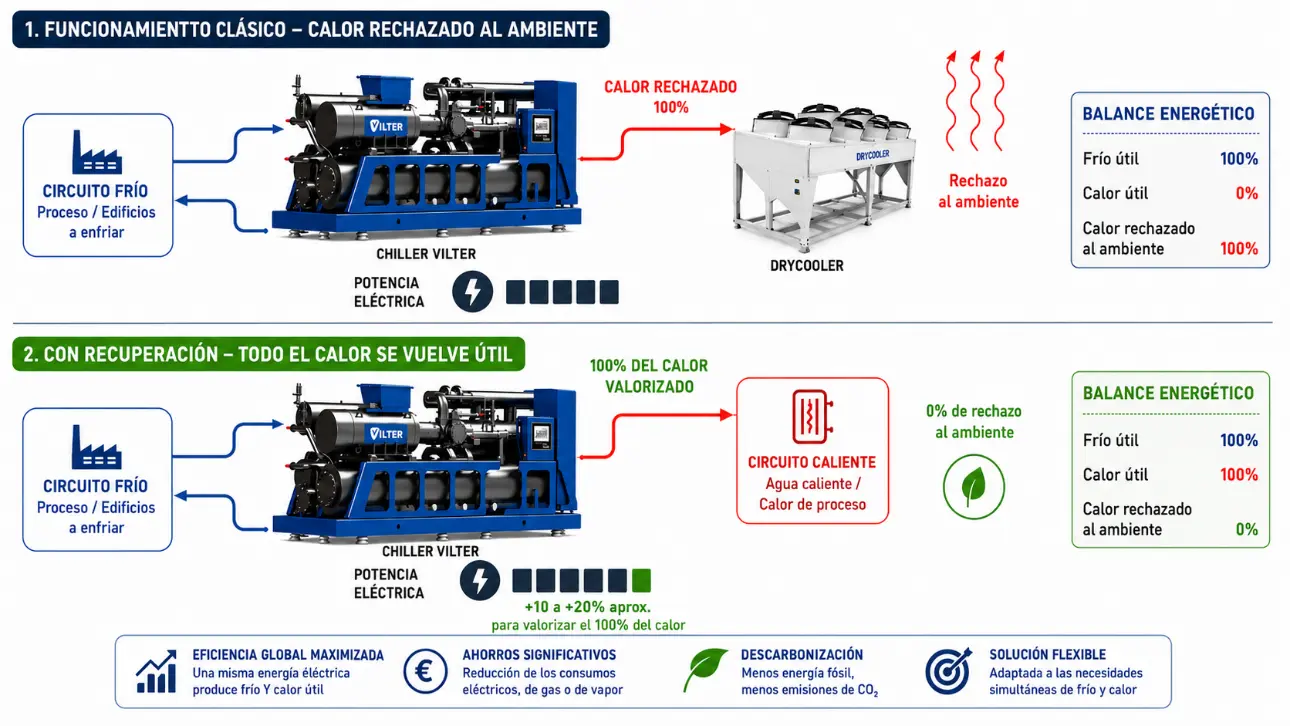
Simplified example
Let's take the example of a chiller cooling a loop at -4/-8°C and rejecting heat to a loop at 37/42°C. The compressor operates at -10/+44°C. 961 kW of cooling, 307 kW of electrical power, 1268 kW in the environment. This same chiller will operate in low condensation at -10/+25°C. 1079.7 kW of cooling, 210.0 kW of electrical power, 1289.7 kW in the environment.
This same chiller in VQ60 version: chiller operation cooling a loop at -4/-8°C and with a rejection on a loop at 45/62°C. The compressor operates at -10/+60°C. 779kW cooling, 526.6 kW electrical, 1305.6 kW useful heat which replaces a gas boiler.
Estimation of the CAPEX overrun: €50k, OPEX overrun to be assessed at an equal cooling power and with the assumption of an electricity cost of €0.10/kWh.
Classic réfrigération mode: COP = 3.13
TFP mode: COP = 3.96
In terms of CAPEX, the VQ60 thermofrigopump enables a significant energy milestone to be achieved for a relatively limited additional investment. With the VSS901 compressor, a conventional chiller operation at -10/+44 °C provides 961 kW of cooling for 307 kW of electricity, while rejecting 1,268 kW of heat to a 37/42 °C loop and then to the environment. Transitioning to a thermofrigopump, with condensation at +60 °C on a 45/62 °C loop, requires an additional investment of approximately €50,000. However, this additional cost grants access to a new function: the heat that was previously wasted becomes useful high-temperature heat, capable of directly replacing gas boiler production. In other words, for a marginal increase in CAPEX, the refrigeration system simultaneously becomes a genuine tool for producing decarbonised heat.
Let us consider an annual operation of 6000 hours, divided into 2000 hours at -10/+42°C and 4000 hours at -10/+25°C for the chiller, and consistently at -10/+60°C for the VQ60.
Over a year of operation, a refrigeration unit naturally benefits from variations in outdoor temperature and can operate for a large part of the time with reduced condensation pressure. In our example, the chiller equipped with a VSS901 compressor operates for 2,000 hours at -10/+42 °C and 4,000 hours at -10/+25 °C. It thus produces approximately 6.24 GWh of cooling per year for an electrical consumption of only 1.45 GWh. To provide exactly the same amount of cooling in thermofrigopump mode at -10/+60 °C, the electrical consumption would be around 4.22 GWh/year, representing an additional cost of 2.76 GWh of electricity, which amounts to approximately €276,000/year with electricity priced at €100/MWh.
This additional electricity, however, allows for the simultaneous production of nearly 10.46 GWh/year of useful heat at a useful temperature, heat that was previously released into the environment. With a gas boiler operating at 90% efficiency and gas priced at €50/MWh, this same amount of heat would have required approximately €581,000/year in fuel. The thermofrigopump thus enables, in this example, a net saving of around €305,000/year, while ensuring exactly the same refrigeration output. Its economic interest is therefore based on a simple principle: to accept a controlled electrical surcharge to transform a considerable amount of waste heat into useful energy and to replace fossil thermal production.
The hot side savings pay for the necessary investment in refrigeration.
Economic
The economic lever of the VQ60 thermofrigopomps is simply magical:
in less than 2 years, the savings made on heating costs will have covered the investment needed for refrigeration production.
.
Range
The VQ60 range is based on compressors with a rotor diameter of 240, 280, or even 310 mm.
Elaborated
The VQ60 is designed to simultaneously produce both cooling and heating, thereby simplifying refrigeration systems and industrial heat pumps. Thanks to the user-friendly interface of the PLC Vission 20/20, operation and maintenance are made easier. Its integrated design reduces the number of necessary equipment while meeting cooling and heating needs. Moreover, the accessible architecture of the VQ60 allows for quick maintenance interventions, thus improving the availability of the installation. Vilter sizing tools enable rapid configuration according to the specific needs of the process.
Flexibility
The VQ60 thermofrigopumps feature a flexible, modular, and scalable design, engineered for seamless production, quick installation and commissioning, as well as easy maintenance. A complete and optimised turnkey system is provided in a single chassis design, without compromising on ease of maintenance.
The VQ60s are equipped with 2 condensers and 2 oil coolers for an efficient, reliable, and flexible machine in operation.